Tuesday, 25 June 2013

The story of my experiments with truth

Madhu Sagar
‘I had picked up Gandhiji autobiography from one of the railway stations on my way to Ambala’ said Madhu Sagar of Bharat Petroleum Corporation Limited (BPCL) in Mumbai and could not put it down till I finished reading it. I decided to bring about three changes in my life immediately. Being truthful, walking everyday and sticking to a simple diet, Sagar recollected. According to her everyone should read the autobiography, especially about his experiments with diet and see the impact on their health also.  Gandhiji inspires people to change and that too only for Rs.40/-, as this is how much Gandhiji’s autobiography costs.  I had met Madhu during my lecture at BPCL on June 18, 2013.  
‘My life is my message’ Mahatma Gandhi had said. Over six decades after his death, his story continues to be an inspiration. His autobiography, ‘The Story of my Experiments with Truth’ generates an average annual royalty between 35-40 lakh and is a best seller that continues to inspire people. Each page one turns, there is a message for self improvement. Gandhi had willed all copy writes of his writings to Navajivan Trust and also decreed that 25% of earnings from sale and royalty of his books should be given annually to Harijan Sewak Sangh for the welfare of Harijans. 

Apart from the autobiography, Navajivan Trust publishes over 600 books and writings by the Mahatma, which add to the revenue generated to his name. Mahatma Gandhi continues to be relevant to the society and its people, not only nationally but also globally. It is time we wake up to our rights and responsibility and make a difference to the society as Gandhi did in his time. 

Mailar Mahadev’s march to Dandi with Gandhiji


Mailar Mahadev (18yrs) second from right 
A year ago I  met  V.P.Baligar, CMD  of the Housing Development Corporation (HUDCO)  who informed me about his uncle Mailar Mahadev, only one from Karnataka who participated in the Dandi march led by Gandhiji . The Salt Satyagraha started on March 12, 1930, with the undertaking of the Dandi March. It was the next significant non-violent protest against the British, after the Non-movement of 1920-22 and India's First War of Independence 1857.
Mailar Mahadev was born on June 8, 1911, into a peasant family in Motebennur, of haveri district. His father was Martandappa and his mother was Basamma, who suffered imprisonment during the freedom movement.
Mahadev renounced his home, family and native place, discontinued his studies at the school level itself. Influenced by the speech of an elderly patriot, he threw away the foreign cap he had on his head.  He had heard about Gandhiji and on his advice began carrying bundles of Khadi on his head and sold it. He went to Kaladagi, in Bijapur district which was then the centre for Khadi, then to Dharwad, then a strong centre of Freedom movement.   He became a member of the Youth League and involved himself in constrictive activities. On R.R. Diwakar’s suggestion Gandhiji included 18 year old Mahadev in the list of 79 persons for the Dandi Yatra. He was arrested at Dandi and imprisoned for six months. His parents went to Bardoli to join the satyagraha. In 1932-33, Sidamma was also arrested and imprisoned for six months at Ahmedabad.
Mahadev continued the khadi propagation and upliftment of dalits through his on ‘Grama Sevaharm’ in 1937 in Koduru. On Gandhiji’s call of ‘Do or Die’ Mahadev and his followers took up activities to force the British administrative machinery to come to a standstill. 
On a fateful day in 1943,  as he got determined to distribute the taxes to the peasants that was forcibly collected by the British government from them, he  lead a team to attack the revenue office in Veerabhadra Temple. He was fired straight on his chest by two soldiers hiding behind the idol. Writhing in pain Mahadev prevented his followers from firing at them as theirs was a peaceful struggle. 

Mahadev was 32 years old at that time, Baligar told me. More than seventy years ago Mahadev set an example of sacrificing his life for the nation. Because of such persons the we are tasting the salt of freedom today.  

Sunday, 16 June 2013

Continuing Gandhi's work

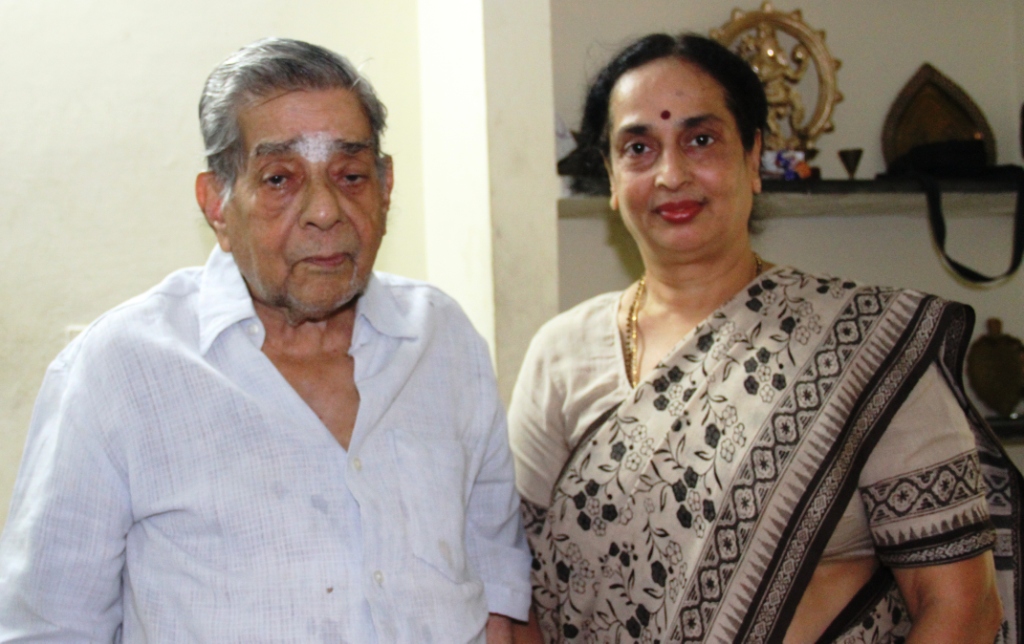
With Shri V.K. Sthanunathan
I met Shri V.K. Sthanunathan in Chennai on June 7, 2013. He is 91 years old and has been the honorary secretary of the autonomous private charitable trust ‘Thakkar Bapa Vidyalaya’.  I was introduced to him by Mr. George Simon, of BHEL, Chennai.  It has been 30 years since Shri Sthanunathan retired as a member of the Railway Board in 1980. Living in the premises of the Tamilnadu Harijan Sevak Samithi, he has devoted the rest of life after retirement working for the Vidyalalya that was established by Thakkar Bapa in 1933 under the directions of Mahatma Gandhi as a Harijan Industrial School to impart skill training.
Thakkar Bapa Vidyalalya
Amritlal V.  Thakkar or Thakkar Bapa was Gandhiji’s contemporary. He was a civil engineer from Gujarat and served the dalits and adivasis. He was an associate of Gokhale ji in the Servants of India Society and took deep interest in Gandhiji’s work. Thakkar Bappa became the secretary of the Harijan Sevak Sangh established by Gandhiji. Throughout his life he was no less committed a servant of the least than Gandhiji.  

Shri Sthanunathan reminisced about his father-in-law, A. Vaidyanatha Iyer who was born in Thanjavur in 1890 in a Tamil Brahmin family. In 1922 Iyer had participated in the non –cooperation movement, in 1930 in the Vedaranayam Salt Satyagraha and the Quit India Movement in 1942. 

On July 8, 1939, seventy five years ago he entered the Meenakshi Sundareswarar Temple in Madurai with six persons belonging to other oppressed castes. The temple entry team was led by Vaidyanatha Iyer and L.N.Gopalasamy, president and secretary of the Tamil Nadu Harijan Sevak Sangh respectively. At 8.45 a.m. a batch of five Dalits and a Nadar – P.Kakkan (who later became Home Minister in Kamaraj Ministry ), Swami Muruganandam, Muthu, V.S. Chinnah, V.R. Poovalingam and S. S. Shunmuga Nadar -- made their first entry into the Meenakshi Temple. Meenakshi Temple entry on July 8, 1939, was the forerunner of the State legislation which conferred on the suppressed section of Hindu society the right to enter temples. Following the temple entry, Chief Minister of Madras Presidency C.Rajagoplachari introduced legislation for the removal of the civil and social disabilities against the depressed classes.

The efforts of Vaidyanatha Iyer to mainstream Dalits transcended the question of patronising as his efforts were genuinely empowering. He not only worked among Dalits but also persuaded upper caste people to change the customs and treat Dalits as equals.

“I am delighted that my many-year-old desire has been fulfilled today.” This is how Mahatma Gandhi wrote in the visitors’ book shortly after offering worship at the Meenakshi-Sundareswarar temple in Madurai, Tamil Nadu, along with Dalits and members of certain other “excluded communities” on February 4, 1946.

During the Quit India movement Vaidyanatha Iyer was imprisoned from 1942-45 in Tanjore jail never hoping to come alive. In 1943 he was allowed one month’s leave to come out of the jail to celebrate his wedding and went back to jail. He was released in 1945. 

Shri Sthanunathan was married to his daughter and continues the tradition so set by his father in law. At 91, he wears no specs and has sharp memory while recounting this incident. All he wants now, is to lead a campaign for prohibition. Gandhiji had spoken ten days before his death about his wish that now that our government has come into place, prohibition must come into effect.   

Wednesday, 12 June 2013

From Mandalay to Wardha

In  March 1920 Gandhiji visited Burma for 13 days for seeking donations for Khadi work.  Buddhists in China, Japan, Ceylon and Burma claimed him as their own. Their monastic training, energy and fearlessness earned the Buddhist monks popular respect and the epithet 'dhammatatikas' or dharma activists. Like Gandhiji , they saw strength in unity, believing that if they maintained continued attachment to India, that  would help achieve home rule more rapidly.

Gandhiji had  stayed with Pranjivan Mehta near the Shwedagon Pagoda. He toured Rangoon, Mandalay,  Mailmein, Myingam and Toungro . Gandhi gave numerous public addresses to audience in the thousands, comprising of Burmese Monks, local public and  the Indian Diaspora. People contributed generously for Gandhi’s cause and he collected Rs.2,60,000 for the khadi work. He also told them to give cultivate faith in the Muslims.


Pd. Mahavir Prasad Trivedi had settled in Burma in Myingam and was eager to help the Swadeshi movement. He was working in the commissioner's office.  Natubhai Jasam, the diamond merchant  from Bombay was his neighbour. Trivedi  spent considerable time discussing with Gandhiji. All round the influence of the Swadeshi movement was quite evident.

Later in the late 1930s ,when his 20-year old son Rameshwar Trivedi wanted to join college in India, Panditji advised him to go to Gandhiji in Wardha.  So, this young man landed in Maganwadi in Wardha and met Gandhiji.  Gandhiji had developed a keen interest in village industry and the uplift of villages.  He had started the constructive programs that could guide the country.  Gandhiji had a special task for Rameshwar- to teach Hindi to Mirabehan according to his nephew Shri Anand Trivedi, whom I met yesterday.

Mirabehan wanted to live and work in a village and built a small  with mud, wattle of palm branches, split bamboo and utilizing ever stone that the blasting of the underground rock in her well made available to her. Gandhi ji described it saying it is not merely a hut. It is a poem.

Mirabehan spent her time spinning, carding weaving, cleaning latrines and working the locals about village sanitation and hygiene.  She was the youngest daughter of an English Admiral in the Royal Navy. Madelein Slade belonged to the British aristocracy. She was advised by Romain Rolland to travel and told to meet Gandhi adding, ‘ He is another Christ’.’ Gandhi gave her the name Mira when she arrived in Sabarmati Ashram on 8 September 1925 and called her his daughter.

Young Rameshwar spent ten years in Sabarwati and Wardha and that too mainly under Gandhiji's directions. 

How his life must have changed during this time and what was his contribution to the Swaraj movement was will soon be revealed to me by Anand Trivedi of MMTC once he checks with his father Shri Ramakrishna Trivedi  in Lucknow.  His father was the former governor of Gujarat  from 1986-1990. Shri  Trivedi said that he frequently visited the Sabarmati Ashram along with his father on different occasions.


Tuesday, 28 May 2013

Charcoal painting of gratitude


Two unlikely persons became  friends in 1944-45, one, a prisoner of war and the other, a lawyer. After the WW-II, many Italian and French soldiers were detained as POW in India. They were taken to Dehradun. On Sundays they were set free to mingle with locals. On one such Sunday , the Italian soldier,  Duccati, saw young men playing volley ball.  He himself was into sports and was instinctively drawn to the field. He made friends with an Indian lawyer, who happened to be an avid volley ball player from Allahabad in U.P., and had just started practicing in Dehradun. They spent the evening together and the lawyer took his friend home for dinner. Thus started a friendship, which transcended the boundaries. They exchanged stories about Mahatma Gandhi over dinner , that soon became a family ritual. 

The Indian lawyer narrated how he was drawn to Mahatma Gandhi as a student pursuing B.A. in the late 1930s. The train carrying Gandhi was  passing through  his home town.  He had to meet Gandhi,  the student was determined.  So, when the train stopped at the Allahabad station, he got into the compartment and found the Mahatma eating from his wooden bowl with a wooden spoon, chewing every morsel slowly and enjoying his snack.

'I want your autograph'. the student demanded "Sure' Said Gandhi, 'You will have to give two rupees towards the Harijan Fund.  'Oh, I do not have so much money and can not give the donation.' retorted the  student. Gandhi kept munching and smiling as the student argued with him for over half an hour. The consummate lawyer put forth his arguments and ultimately won over the case from the  lawyer to be.  

Thus, the friends kept talking about Mahatma Gandhi, admiring him for leading the non-violent struggle and freeing the nation. Soon it was time to go back home for the Italian soldier. He wanted to give a parting gift to his dear friend. He asked for a paper and some charcoal. What came out of his deft hands was a charcoal painitng of Gandhi , autographed by him. Such was the influence of the' Great Soul'.    

The lawyer, Chaudhary Puran Singh was overwhelmed and preserved the charcoal drawing as a mark of his friendship for a long time till the paper disintegrated into shreds years later.


This was narrated to me by Pradeep Singh, son of  Chaudhary Puran Singh Singh, whom I met after my lecture at  ONGC Academy Dehradun today. Till, then wait for more details.

Saturday, 25 May 2013

Gandhi and Me

I'm starting this blog because I feel the need to fill the gap between what Gandhi taught us and what we know about him today. My idea is to reintroduce the Gandhian philosophy to this generation in a way that people can relate to and put it in practice.

I read this quote somewhere today, which inspired me to start this blog:

"You may never know what results come of your actions, but if you do nothing, there will be no result." - M.K. Gandhi

In the coming days I will be talking about my experiences in the Gandhian field and how I am reaching out to people in the corporate world to make them understand how we can look at M.K. Gandhi as a role model for ethical business practices.

I will also be talking about the impact he has made in my life and how things changed for me. I hope, that through this blog, I will be able to paint a clear picture of my relationship with Gandhi and his actions. I will discuss the things I have read, my experiences in Sewagram and my father's contribution in this field.

Till then, watch this space for more and live long and prosper.