|
| Dandhi March with Mahatma Gandh and his 79 followers |
Through the Dandi march Gandhi
wanted to show to the world that nonviolence is powerful weapon in the important,
‘battle for Right versus Might.’ He had said, ‘this is an opportunity of a lifetime.’ As in all Gandhi’s satyagaha and marches a basic set
of rules were followed in the Dandi march-the issue was clearly identified on
the issue on which the struggle would be launched, it’s ‘Truth’ was highlighted
to the opponents and negotiation was requested , the opponent and the news media
were fully informed of the campaign’s
objectives and plans, funds were raise and the effort was to economize on
expenditure and trouble so as to sustain
the satyagraha as long as necessary and sustainable arrangements were made for
identifying leaders in case of arrests, care of those who would be injured or
arrested, as well as for their families.
According to the eminent scholar Anand Kumarasamy in his book on ‘Gandhi on Personal Leadership’ , Pandit Jawaharlal Nehru would write many years
later, ‘Many pictures rise in my mind of
this man {Gandhi} ….but the picture that is dominant…is as I saw him marching,
staff in hand, to Dandi on the salt march in 1930. Here was the pilgrim on his
quest of truth, peaceful, determined and fearless, who would continue that
quest and pilgrimage, regardless of consequences.’
The prime elements in Gandhi’s satyagraha,
fasts, padayatras, marches, prayer meetings and negotiations with political
rivals and the British rulers were-transparency, methodical humane approach and
insistence on ‘purity of means’ to achieve the desired goals. His methodical
approach is best seen in the historical ‘Dandi march’, through which one can take
lessons of Gandhi’s outstanding leadership achievements. Gandhi’s leadership,
completely self-made sprouted and grew to full stature as his ‘Experiments with
Truth’ and application of the ‘Eternal Verities”, to his daily challenges
progressed. He neither had the benefit of personality development,
communication, organization, management or leadership courses, nor good looks
nor great oratory. His only guidance came from his ‘inner voice’ writes the
eminent scholar P.A. Nazareth in his
book ‘Gandhi’s Outstanding Leadership’.
The Indian National Congress had
declared January 26th as the ‘Poorna
Swarajya’ day in Lahore. In the cities and towns thousands of people
recited a declaration of independence to show their support for ‘swaraj’. ‘We believe that it is the
inalienable right of Indian people, as of any other people to have freedom, and
to enjoy the fruit of their toil and have the necessities of life so they may
have full opportunities for growth.’ On January 18th, 1930, poet
Rabindranath Tagore paid Gandhi a visit. He asked him what he had in mind for
India. Gandhi said he did not know. ‘I am
furiously thinking night and day’, he replied, ‘and I do not see any light coming out of surrounding darkness’.
Courage
of conviction
The country was eager for the civil
disobedience movement after the Lahore Congress. People awaited Gandhi’s
announcement of the program anxiously. For many days he had groped in vain for
inspiration. Finally it had come to him in a flash. Once he was convinced of
the program, Gandhi had not wasted his time and placed it before the country. Gandhi
believed that the moment was now ripe for the new dramatic and completely
non-violent campaign: the Salt Satyagraha. His ingenuity lay in being
transparent.
The issue of civil disobedience
was made public. In his letter to the Viceroy, Gandhi had declared that he
would break the Salt Act by marching from the Sabarmati Ashram. He had
addressed the British Viceroy in India, addressing the letter as ‘Dear Friend’.
This was always a part of the Gandhian method; in his world view, there were no
enemies, because he was fighting the evil of the system and not these
individuals. The letter announced the date of commencement of the movement as
11 March, 1930 which was later changed to 12 March, 1930. It was still not
certain as to where the march would conclude.
When the British Viceroy rejected
eleven demands Gandhi had articulated as the essence of self-government in his
letter, he decided to directly attack the salt law, which taxed staple of rich
and poor alike-and also outlawed the manufacture of one’s own salt, as well as
the purchase of untaxed domestic salt. Gandhi,
the satyagrahi, hated the sin, but
not the sinner. He wrote, ‘They said they did not want to meet me
saying ‘talking to you is useless.’ Hence
Gandhi ji said ‘when I asked for rotis,
they gave me stones in return.’
Judith Brown's biography of Gandhi,
‘Prisoner of Hope’ expertly evokes
the life and work of Mahatma Gandhi as a multi-faceted genius who introduced a
new sense of social reform, political opposition, and spiritual idealism. Brown extols salt march as a ‘superbly ingenious choice’.
Martin Luther king jr. once said
‘If humanity is to progress, Gandhi is inescapable.’ The salt march was his
favorite Gandhi story. According to historian Taylor Branch, King would tell
the story with gusto. When he described Gandhi picking up the salt in Dandi,
King would exclaim, ‘It seems, I could hear the boys at number ten Downing
Street in London, England, say, ‘it is all over now’!
Why
salt?
When Gandhi announced his plan,
even his close aides and associates were completely unconvinced. The Indian
National Congress was mystified and incredulous. Of all things, why salt? Many leaders had felt that the
choice of salt tax as an issue was insignificant and that it would divert the
attention from the more significant issue of complete independence or Poorna Swaraj. Their apprehension was
laid to rest by the reception that the Dandi march received. The courage and
forbearance of the people across the country were such that the skepticism of
the critics was dissolved. Gandhi had
outlined his plan to ‘raid’ the salt works at Dharasana in his letter to the Viceroy of India. He was arrested
before he could carry out the ‘raid’. With his arrest the non-violent agitation
gathered more strength according to Narayan
Desai, Eminent Gandhian in his book
‘My Life is My Message’.
Gandhi once again proved that he
was no mere saint like figure, but also a superb strategist, a practical idealist.
He said he was an idealist who put the ideas into practice immediately. Dandi
march would prove to be his masterstroke, as it was a plan that was at once
simple and brilliant. Salt for Gandhi, was largely symbolic; by choosing salt
as an issue, Gandhi was showcasing the heartlessness of an Empire that would
tax something so basic and essential to the human diet. It served as a powerful
symbol of a callous and cruel colonial exploitation, imposing burdens on the
already poor millions. What was even more ridiculous that salt could be made
freely on the sea shore, yet no Indian was allowed to make it. If ever a law could be unjust, here was one.
Above all, given the essential nature of its use this issue would cut across
all lines of caste, creed, state and language. Finally, it was a powerful issue
for the Indian women struggling to feed her family.
Organizational
skills and Charisma
Gandhi’s organizational skills
are best seen in the manner in which he reconstructed the Indian National
Congress between 1915 to 1930. Gandhi knew that the salt satyagraha would be a definitive
step towards freedom. This experiment in non-violence suppressed the sporadic
but widespread incidents of violence and infused people with positive energy.
The reason was that Gandhi, the practical idealist had the vision that he would
walk to the seashore and make salt. In one of the most illuminating moment of
India’s non-violent struggle for freedom, Gandhi chose Sardar Vallabhbhai Patel
who could execute his vision perfectly. This was the finest example of the executive
foresight of the Mahatma.
Starting from Ahmedabad on 12
March 1930 with 79 of his well-trained, handpicked followers Gandhi led a 240 -mile long march to the sea
at Dandi, where he intended publicly to break the law by ‘making salt’- that is
gathering natural sea salt that had crystallized under the sun on the beach. The
Dandi march, in which every detail was carefully planned, passed through areas
well prepared for satyagraha and whose progress was eagerly followed by Indians
all along the route to Dandi, on the coast of the Arabian Sea. The marchers did
not carry a single flag or banner. Gandhi
walked fast, but he increased his speed further to save himself from the rising
dust and those wanting to touch his feet. Three film crews captured this walk
and, Gandhi’s fast paced walk became legendary.
The Gujarat Vidyapeeth had deputed ‘Arun
Tukdi’, a vanguard that reached the stops as an advance party that gave Gandhi
all the information about the villages. Gandhi, who understood the Indian
villages more than anyone else, explained the economics, the ethics and the politics
of the salt law. He was to do this all along the route of the Dandi march. The march
was a means of awakening the people.
Leading
by example
Gandhi’s great achievement in
including the band of satyagrahis who accompanied him in the
Dandi march , and subsequently many other such
people from India and abroad , to
join him is ample proof of his incredible charisma. The Sabarmati Ashram was
buzzing with excitement as everyone in the Ashram was awake on the night
between the 11th and 12th March, 1930. There were long lines of vehicles along with
people of the entire village who had assembled there. When the whole Ashram was
awake, the only person who was sleeping soundly was Gandhi. He was not worried about what was going to
happen the next day and so he slept! He
had this unique quality of ‘Sattva’, or
calmness of mind which enabled him to remain positive even under all difficult circumstances.
The group walked in the early
morning, rested during the hottest part of the day and walked to that evening
destination in the late afternoon. At nights they slept at Dharmashalas, or village inns, instead of in private homes. That way there would be no retaliation
against the home owners who might welcome them. Each village provided Gandhi with an opportunity to lead by example. It was not enough
for Gandhi to march on an average of 12 miles (19 kms) a day over dusty roads
in the hot month.
Communication
skills
Gandhi also kept up heavy writing
schedule. He wrote regular articles and on March 24, 1930 he produced seven
articles for ‘Young India’. Gandhi’s communication skills transformed India’s
freedom struggle from one waged by a small elite, urban group into a mass
movement in which millions of Indians from every stratum of society
enthusiastically participated. It was the largest ‘people power’ struggle in
the history.
His historic salt march and his
publicly breaking the salt law was a communication masterpiece. News about it
was carried in over 1000 newspapers worldwide. The New York Times editorialized
that whereas Britain had lost America on tea, it was losing India on salt! TIME
magazine put him on the front cover of its January 4, 1931 issue as the ‘Man of
the Year.’
 |
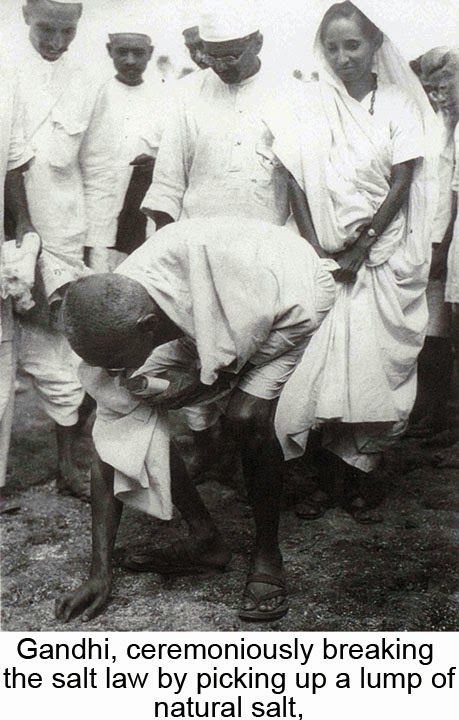
| Gandhi picking up a fistful of salty mud., April 6th , 1930 |
The event, which was widely
covered by the press, thrilled the nation and electrified the world, and when Gandhi
reached the ocean and picked up a fistful of salty mud on April 6, 1930, Indian
began making and selling illegal salt everywhere. Gandhi and others were
quickly rounded up, but their arrest only raised the pitch of the resistance
and increased the intensity of the world’s focus on India, finally pressurizing
the British Viceroy into repealing the salt tax and other repressive measures
according to the management guru and author Alan
Axelrod.
Triumph
of Spirit of the Non Violence
The remarkable and unprecedented
events of Dandi culminated at the Dharasana salt works. Gandhi was now in
prison, but another protégé of Gandhi, Sarojini Naidu, led a group of 2500
volunteers and Satyagrahis in a
non-violent raid into the salt works. Web Miller, the American journalist from Chicago Daily News, who was the eye
witness to the events of 21 May, 1930 recounts, ‘Next leader was Manilal Gandhi, second son of Gandhi walked amongst the
foremost of the marchers. As the throng drew near the salt panes they commenced
chanting the revolutionary slogan’ Inquilab Zindabad’ intoning the two words over and over again. The leaders who had the ropes, attempted to lasso the posts holding up
the barbed wire, intending to uproot them; the police ran up and demanded that
they disperse. The volunteers refused. The column silently refused the warning
and slowly walked forward…Suddenly, at a word of command; scores of native
police rushed upon the advancing marchers and rained blows on their heads with
steel shod lathis. Not even one of the marchers even raised an arm to fend off
the blows. They went down like ten-pins. From where I stood, I heard the
sickening whack of the lathis on the unprotected skulls. The waiting crowd of
watchers groaned and sucked in their breath in sympathetic pain at every blow.’
In the order of leadership
Naraharibhai Parikh was the fourth. Lathis were showered on Naraharibhai and
blood was oozing from his head and covered the whole of his body. Gandhi was
not there but 40 representatives of the press were there to collect news as
Naraharibhai fell down unconscious. When asked for a message he said, ‘I am doubly blessed, because till now the
leaders were arrested and the volunteers had to face physical assault. And now,
I first faced the blows and then I am being arrested and that is why I am
doubly blessed.’
The pious sacrifice of Dharasana
created conditions that allowed a representative of the enslaved people to
negotiate with the representative of the Empire as an equal.
Those were the days of the Salt
Satyagraha, but even after that the mood of agitation continued as active youth
took on the agitation with determination, ready to be martyred. Gandhi’s color
had rubbed onto everyone. And if there was one reason above this, it was that
everyone had tasted the Sabras or
Salt of Independence with greater enthusiasm as Gandhi lifted a pinch of salt
at the Dandi shore: Swaraj was now at the doorstep.
Gandhi had viewed the civil disobedience
movement as a challenge to the spreading violence in the country. He believed
that if the spirit of non-violence became pervasive the forces of violence
would weaken. He had therefore, also announced that the struggle would continue
even if incidences of violence were to occur. These were testing time, for and
every incidence of violence caused him deep personal pain. He shared his
feelings with the readers of Navajivan, April
27, 1930 ‘This is a struggle between violence and non-violence. To the extent
that I am non-violent in spirit, non-violent remedies will occur to me; and
these I shall put before the people so long as I remain free. In my absence
also, if there spirit of non-violence has become general, people will follow
non-violent methods. Those who have not come under the spell of non-violence
are bound to do so in the end if the true spirit of non-violence comes to
prevail among the people.’
The civil disobedience movement
became stronger after Gandhi’s arrest in 1930. A much greater surge of
sacrifice was seen in 1930-31 when all people from all walks of life joined the
struggle. The crucial lesson we learn from all these examples is that while
conscience helps us distinguish right from wrong, it is our courage that enables us to speak out and
take actions against injustice and cruelty. It is courage that makes it
possible to stand up for what we believe in.
Gandhi’s salt march united all
Indians in peaceful protest for independence. Gandhi’s philosophy for
nonviolent action overpowered the British government and his actions influenced
civil rights movement around the world like defiance campaign against Apartheid
Laws in South Africa 1952, U.S. civil rights movement in 1963, Cesar Chavez and
the Delano Grape Strike in California 1965 and many more.
The path that Gandhi took is open
to all those willing to adopt his principles and dedication.